
A 2023 study in Experimental Physiology found that bodyweight resistance training produced muscle hypertrophy comparable to free weight training over an 8-week period. The gym is not the only path to a stronger body. With the right programming and progressive approach, home workouts deliver real, measurable results — and 51% of U.S. exercisers now prefer training at home over going to a gym.
Quick Summary:
- Home workouts produce muscle and strength gains comparable to gym training when properly programmed
- You can start with zero equipment and progressively add gear as you advance
- Three equipment tiers let you scale your home training from bodyweight to a full setup
- Progressive overload at home relies on rep increases, tempo changes, and exercise variations
- Consistency and structured programming matter more than fancy equipment
Why Home Workouts Actually Work
The idea that you need a commercial gym to build muscle is outdated. Research published in the Journal of Strength and Conditioning Research confirms that low-load resistance training produces hypertrophy gains equal to high-load training — quadriceps growth of 7.8% with lighter loads versus 8.1% with heavy loads, with no significant difference between groups.
What drives muscle growth is mechanical tension and metabolic stress, not the specific tool you use. A push-up taken to near failure stimulates the same muscle-building pathways as a bench press. A Bulgarian split squat with a loaded backpack challenges your quads just as effectively as a leg press.
The key advantage of home training goes beyond convenience. U.S. exercise data shows that people who train at home exercise several times per week at a 10% higher rate than gym-goers. Removing the commute, the wait for equipment, and the monthly fee eliminates the biggest barriers to consistency — and consistency is the single most important factor in long-term results.
Home workouts also offer total control over your training environment. You pick the music, the temperature, and the schedule. No waiting for a squat rack at 5:30 PM on a Monday.
Setting Up Your Training Space
You need less space than you think. A 6-by-8-foot area provides enough room for push-ups, lunges, jump squats, and dumbbell work.
Flooring: Hard floors work for bodyweight training, but a Manduka PRO Yoga Mat (around $120) protects your joints during floor exercises and provides grip for planks. For dumbbells, rubber gym tiles ($1-2 per square foot) protect your floor.
Ventilation: Open a window or position a fan nearby. Air circulation prevents overheating and keeps your grip dry during intense sets.
Ceiling height: Standard 8-foot ceilings work for most exercises. Overhead presses and jumps may require a garage or basement with higher clearance.
Storage: A small corner or closet shelf holds resistance bands, a mat, and a pair of dumbbells. Home training does not demand a dedicated room.
Equipment Tiers: Start Where You Are
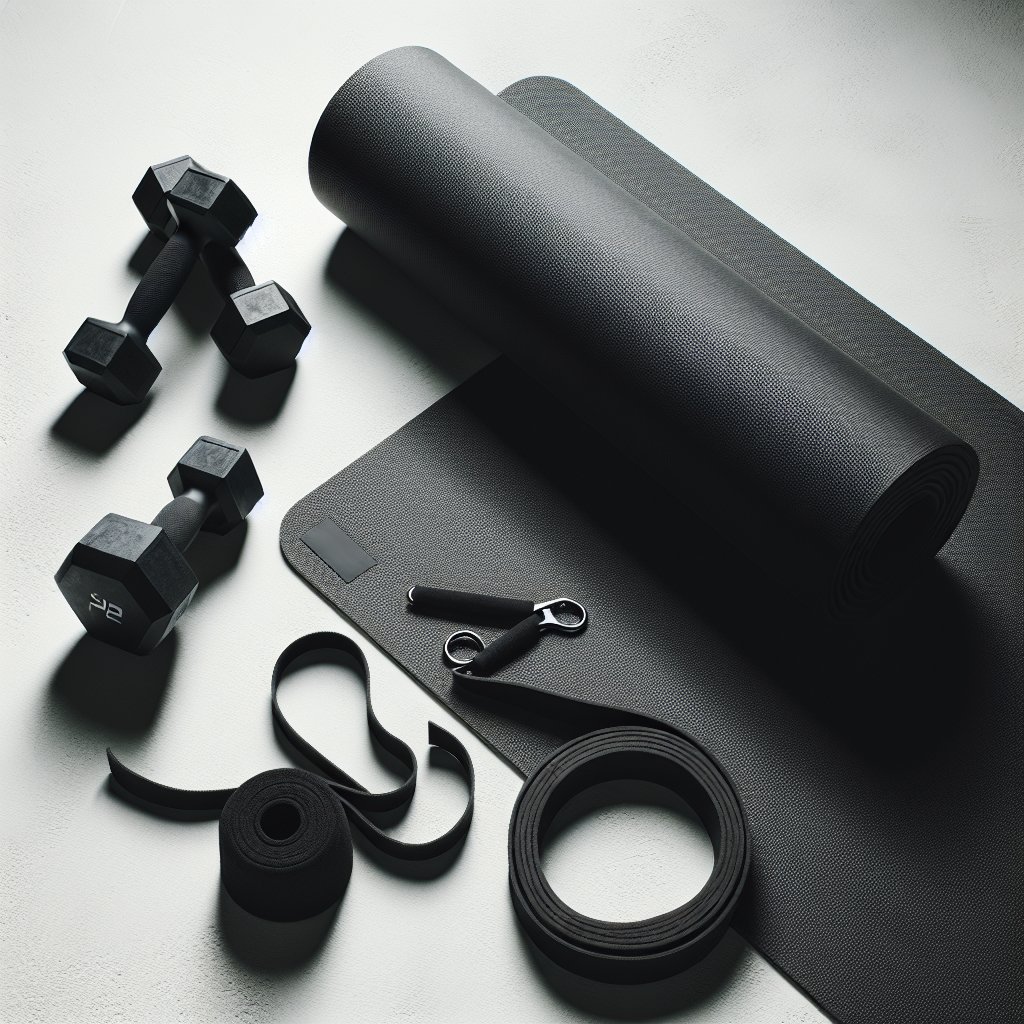
The best home gym is the one you actually use. These three tiers let you start with nothing and build up over time.
Tier 1: Bodyweight Only (Cost: $0)
No equipment, no excuses. Bodyweight training builds real strength and muscle, especially for beginners and intermediates.
Key exercises: Push-ups (and all variations), squats, lunges, glute bridges, planks, mountain climbers, burpees, pike push-ups, and single-leg Romanian deadlifts.
Best for: Beginners, travelers, and anyone testing whether home training fits their lifestyle. Check out our complete no-equipment workout guide for detailed routines.
Tier 2: Resistance Bands + Mat (Cost: $30-150)
Adding resistance bands transforms your options. Bands provide variable resistance — tension increases as you stretch them — creating a unique stimulus your muscles cannot get from bodyweight alone.
A set of Fit Simplify Resistance Bands (around $12) covers five resistance levels and fits in a drawer. Pair them with a TRX All-in-One Suspension Trainer (around $130) for rows, chest presses, and dozens of other movements that use your body angle to adjust difficulty.
Key exercises: Banded squats, banded push-ups, band pull-aparts, face pulls, lateral walks, suspension rows, suspension chest press, and banded Romanian deadlifts.
Best for: Intermediate trainees and anyone who wants variety without taking up space. Read our resistance bands guide for programming details.
Tier 3: Dumbbells + Bench (Cost: $500-800)
This is where home training matches a commercial gym. Adjustable dumbbells and a bench give you access to every major movement pattern: pressing, pulling, hinging, squatting, and carrying.
PowerBlock Elite Series dumbbells (around $350) adjust from 5 to 50 pounds per hand, replacing 16 pairs of fixed dumbbells. Pair them with a REP Fitness Adjustable Bench (around $300) that goes flat, incline, and decline.
Key exercises: Dumbbell bench press, bent-over rows, overhead press, goblet squats, Romanian deadlifts, lunges, chest flyes, lateral raises, and farmer carries.
Best for: Anyone serious about building muscle and strength at home long-term. See our best dumbbells guide and home gym essentials for gear recommendations.
Verdict: You do not need a gym membership or expensive equipment to build muscle and get stronger. Start at Tier 1, follow a structured plan, and add equipment only when your progression demands it. A $12 set of resistance bands and your own body weight will outperform a $50/month gym membership you never use.
Sample Workout Plans for Each Tier
These plans follow a 3-day-per-week full-body structure, with each session running 30-45 minutes.
Tier 1: Bodyweight Full-Body Workout
| Exercise | Sets | Reps | Rest |
|---|---|---|---|
| Push-ups | 3 | 10-20 | 60s |
| Bodyweight squats | 3 | 15-25 | 60s |
| Inverted rows (table/door) | 3 | 8-15 | 60s |
| Glute bridges | 3 | 15-20 | 45s |
| Pike push-ups | 3 | 8-12 | 60s |
| Reverse lunges | 3 | 10-15/leg | 60s |
| Plank hold | 3 | 30-60s | 45s |
Tier 2: Bands + Bodyweight Workout
| Exercise | Sets | Reps | Rest |
|---|---|---|---|
| Banded push-ups | 3 | 10-15 | 60s |
| Banded goblet squats | 3 | 12-20 | 60s |
| Suspension rows | 3 | 10-15 | 60s |
| Banded Romanian deadlifts | 3 | 12-15 | 60s |
| Band face pulls | 3 | 15-20 | 45s |
| Banded lateral lunges | 3 | 10-12/leg | 60s |
| Dead bugs | 3 | 10/side | 45s |
Tier 3: Dumbbell + Bench Workout
| Exercise | Sets | Reps | Rest |
|---|---|---|---|
| Dumbbell bench press | 4 | 8-12 | 90s |
| Goblet squats | 4 | 10-15 | 90s |
| Dumbbell bent-over rows | 4 | 8-12 | 90s |
| Dumbbell Romanian deadlifts | 3 | 10-12 | 90s |
| Dumbbell overhead press | 3 | 8-12 | 60s |
| Dumbbell lunges | 3 | 10-12/leg | 60s |
| Dumbbell farmer carries | 3 | 40s | 60s |
For more structured programming ideas, check out our full-body workout guide.
Programming and Progression at Home
Progressive overload — gradually increasing the challenge — is what turns casual exercise into real results. At the gym, you add 5 pounds to the bar. At home, you have more tools than you might expect.
Add reps first. If you can do 3 sets of 10 push-ups, work toward 3 sets of 15. Once you hit the top of your rep range, progress to a harder variation.
Slow the tempo. A 3-second lowering phase on squats makes 15 reps feel like 25. Tempo creates more time under tension without adding weight.
Shorten rest periods. Cutting rest from 90 seconds to 60 seconds increases metabolic stress and cardiovascular demand.
Progress to harder variations. Push-ups go from wall, to knees, to standard, to decline, to archer, to one-arm. Squats go from two-leg to split squat to Bulgarian split squat to pistol squat.
Add external load. A loaded backpack, water jug, or bag of sand adds resistance to any bodyweight exercise. This bridges the gap between Tier 1 and Tier 3.
Increase volume. Adding a fourth set to your key lifts increases total training volume, one of the primary drivers of hypertrophy. Our budget home gym guide covers affordable ways to expand your options.
Common Mistakes in Home Training
Skipping warm-ups. Spend 5 minutes on dynamic stretches and light movement before training. Cold muscles are injury-prone muscles.
No structure or plan. Random exercises produce random results. Follow a written program with specific exercises, sets, reps, and rest periods.
Avoiding legs. Home trainers gravitate toward push-ups and crunches. Your legs contain the largest muscle groups in your body. Never skip squats and lunges.
Too much cardio, not enough resistance. Jumping jacks burn calories, but they do not build muscle the way structured resistance training does. Include dedicated strength work in every session.
Stopping when it gets hard. Training close to muscular failure is essential for hypertrophy with bodyweight exercises. The last 2-3 difficult reps matter most for growth.
Never progressing. Doing the same 3 sets of 10 push-ups for six months leads to a plateau. Your body adapts. Increase the challenge through reps, tempo, variations, or load.
Frequently Asked Questions
Can you build muscle with home workouts?
Yes. A 2023 study in Experimental Physiology found that bodyweight training produced muscle hypertrophy comparable to free weight training. The key is training close to failure and progressively increasing difficulty over time.
How often should I do home workouts?
Three to four days per week is optimal for most people. Full-body sessions 3 days per week with at least one rest day between sessions allow for adequate recovery and progressive overload.
Are home workouts as good as the gym?
For most goals — muscle building, fat loss, and cardiovascular health — properly programmed home workouts produce results comparable to gym training. The gym has an advantage for advanced lifters who need very heavy loads.
How long should a home workout last?
Effective home workouts run 30-45 minutes. Research shows that time-efficient training with shorter rest periods and compound movements produces significant strength and hypertrophy gains.
What is the minimum equipment I need?
Nothing. Bodyweight exercises alone build strength and muscle for beginners and intermediates. Adding a set of resistance bands (around $12) significantly expands your exercise options.
Can I lose weight with home workouts?
Yes. Weight loss depends on a caloric deficit, and home workouts burn calories while preserving muscle mass. Resistance training plus controlled nutrition produces the best body composition results.
How do I stay motivated working out at home?
Set a fixed training schedule, track your workouts, and follow a structured program with clear progression targets. Specific performance goals — like a one-arm push-up or 50 consecutive squats — keep training engaging.
Do I need a lot of space for home workouts?
No. A 6-by-8-foot area is enough for bodyweight exercises and dumbbell training. A yoga mat defines your training zone and fits in any room.
What should I eat before a home workout?
A small meal with carbs and protein 60-90 minutes before training fuels performance. A banana with peanut butter or oatmeal with whey protein works well.
How do I know when to upgrade my equipment?
When you complete all sets at the top of your rep ranges with controlled form and have exhausted tempo and variation progressions, add resistance. This usually happens 3-6 months into consistent bodyweight training.
Can home workouts replace personal training?
Home workouts replace the physical gym space, but beginners benefit from professional form coaching. Many trainers now offer virtual sessions that pair well with home setups.
The Bottom Line
Home workouts build real muscle and strength when you follow a structured plan and progressively increase the challenge. Start with bodyweight exercises, add equipment as you advance, and prioritize consistency over perfection. The best gym is the one you actually show up to — and when it is ten feet from your couch, showing up becomes the easy part.
Sources:
- Ogawa M, et al. Effects of free weight and body mass-based resistance training on thigh muscle size, strength and intramuscular fat. Experimental Physiology. 2023. https://pubmed.ncbi.nlm.nih.gov/37133323/
- Schoenfeld BJ, et al. Effects of Low- vs. High-Load Resistance Training on Muscle Strength and Hypertrophy in Well-Trained Men. Journal of Strength and Conditioning Research. 2015. https://pubmed.ncbi.nlm.nih.gov/25853914/
- Schoenfeld BJ, et al. Strength and Hypertrophy Adaptations Between Low- vs. High-Load Resistance Training: A Systematic Review and Meta-analysis. Journal of Strength and Conditioning Research. 2017. https://pubmed.ncbi.nlm.nih.gov/28834797/
- Iversen VM, et al. No significant difference in hypertrophy from machines vs. free weights. Sports Medicine. 2021. https://pubmed.ncbi.nlm.nih.gov/34609100/
- Home fitness in the United States. Statista. 2024. https://www.statista.com/topics/12564/home-fitness/
- Lacroix A, et al. Effects of supervised vs. home-based exercise programs on physical fitness. Ageing Research Reviews. 2021. https://pubmed.ncbi.nlm.nih.gov/33571702/